Sunday, 14 January 2018

Handbooks on Eritrea, Ethiopia, Somalia, Djibouti prepared by the British Foreign Office 1920

In preparation for the peace conference that was expected to follow World War I, in the spring of 1917 the British Foreign Office established a special section responsible for preparing background information for use by British delegates to the conference. In a series of more than 160 studies produced by the section, most of which were published after the conclusion of the 1919 Paris Peace Conference.

Eritrea:

Eritrea is Number 126 in a series of more than 160 studies produced by the section, most of which were published after the conclusion of the 1919 Paris Peace Conference. The book covers physical and political geography, political history, social and political conditions, and economic conditions. At the time the study was written, Eritrea was an Italian colony. With the encouragement of the Italian government, the Rubattino Shipping Company began acquiring territories from local sultans on the shores of the Red Sea as early as 1869, and in 1890 Italy consolidated its possessions on the Red Sea under the name Eritrea. The historical section traces the late-19th century struggle for influence and control in the region involving, at different times, Egypt, Turkey, Britain, and Abyssinia (Ethiopia). The economic section discusses prospects for development of the colony itself, chiefly as a location for Italian-owned plantations worked by indigenous labor, and its importance as an outlet to the sea for Abyssinia. Eritrea remained an Italian colony until World War II, when it was occupied by the British. In December 1952 it was federated with Ethiopia. After a long war of independence, it gained international recognition as an independent country on May 24, 1993.

https://dl.wdl.org/11917/service/11917.pdf
---------------------------------------------------------------

Abyssinia:

Abyssinia is Number 129 in a series of more than 160 studies produced by the section, most of which were published after the conclusion of the 1919 Paris Peace Conference. The book includes sections on physical and political geography, political history, social and political conditions, and economic conditions. It summarizes the history of Abyssinia  (now known as Ethiopia) from its origins in Biblical times, through early contacts with Europeans in the 18th century, to the reign of Emperor Menelik II (1889−1913) and his victory over Italy in the war of 1895−96. The study notes that one of the principal results of the 1896 treaty of peace with Italy was “the recognition without reserve of the absolute independence of the Ethiopian Empire as a sovereign and independent state.” The book discusses the Ethiopian Church and its relationship to the Coptic Church of Egypt, as well as the Muslim, Jewish, and animist minorities living in the country. The economic section emphasizes the low level of agricultural and industrial productivity and the feudal system of land tenure. Foreign trade was beginning to grow, with the main exports being coffee beans and cattle hides.


British Somaliland:

British Somaliland (the northwest part of present-day Somalia) was a British protectorate, established in 1884−7, after a period of rivalry between Britain and Egypt (then nominally still part of the Ottoman Empire) for control of the territory on the African side of the Gulf of Aden. Sokotra (part of present-day Yemen) is an island in the Indian Ocean lying south of the Arabian Peninsula, which became a British protectorate in 1886. Both British Somaliland and Sokotra were regarded as strategically important for controlling the ocean trade routes from the Suez Canal to India, Australia, and the Far East. The book includes sections on physical and political geography, political history, social and political conditions, and economic conditions. The section on political history summarizes the parts played by Great Britain, France, and Italy in this region of Africa and recounts the recurring difficulties the British and Italians had in subjugating the local religious leader and Somali nationalist Sayid Mohammed Abdullah Hassan, a man the British called "the Mad Mullah," who preached holy war against the colonial powers and the neighboring Abyssinians (Ethiopians). The economic section notes the underdeveloped state of both protectorates, observing, for example, that there “are no roads in British Somaliland in the European sense of the word.”

https://dl.wdl.org/11787/service/11787.pdf
--------------------------------------------------

Italian Somaliland:

Italian Somaliland is Number 128 in a series of more than 160 studies produced by the section, most of which were published after the conclusion of the 1919 Paris Peace Conference. Italian Somaliland (part of the present-day Republic of Somalia) came under Italian control in early 1889, when the sultan of Obbia (present-day Hobyo) concluded a treaty with Italy placing his dominions along the coast of the Indian Ocean under Italian protection. Southern Somaliland was made an Italian crown colony in 1910, while Northern Somaliland remained an Italian protectorate, “ruled by local Sultans, over whose actions the Italian Government exercises only indirect political control.” The book includes sections on physical and political geography, political history, social and political conditions, and economic conditions. It chronicles the establishment of Italian control and the demarcation of boundaries between Italian Somaliland and British East Africa and Abyssinia (Ethiopia). The section on social and political conditions is brief and stresses the strict Islamic faith of the Somali tribes. The study discusses the commitment of the Italians to turning Italian Somaliland into an economically profitable colony but notes the many obstacles to be overcome, including the dry climate and shortages of water, the lack of qualified labor for agricultural work, and the rudimentary transport network. It notes the prevalence of slavery in the southern part of the colony.

https://dl.wdl.org/11876/service/11876.pdf

--------------------

French Somaliland:

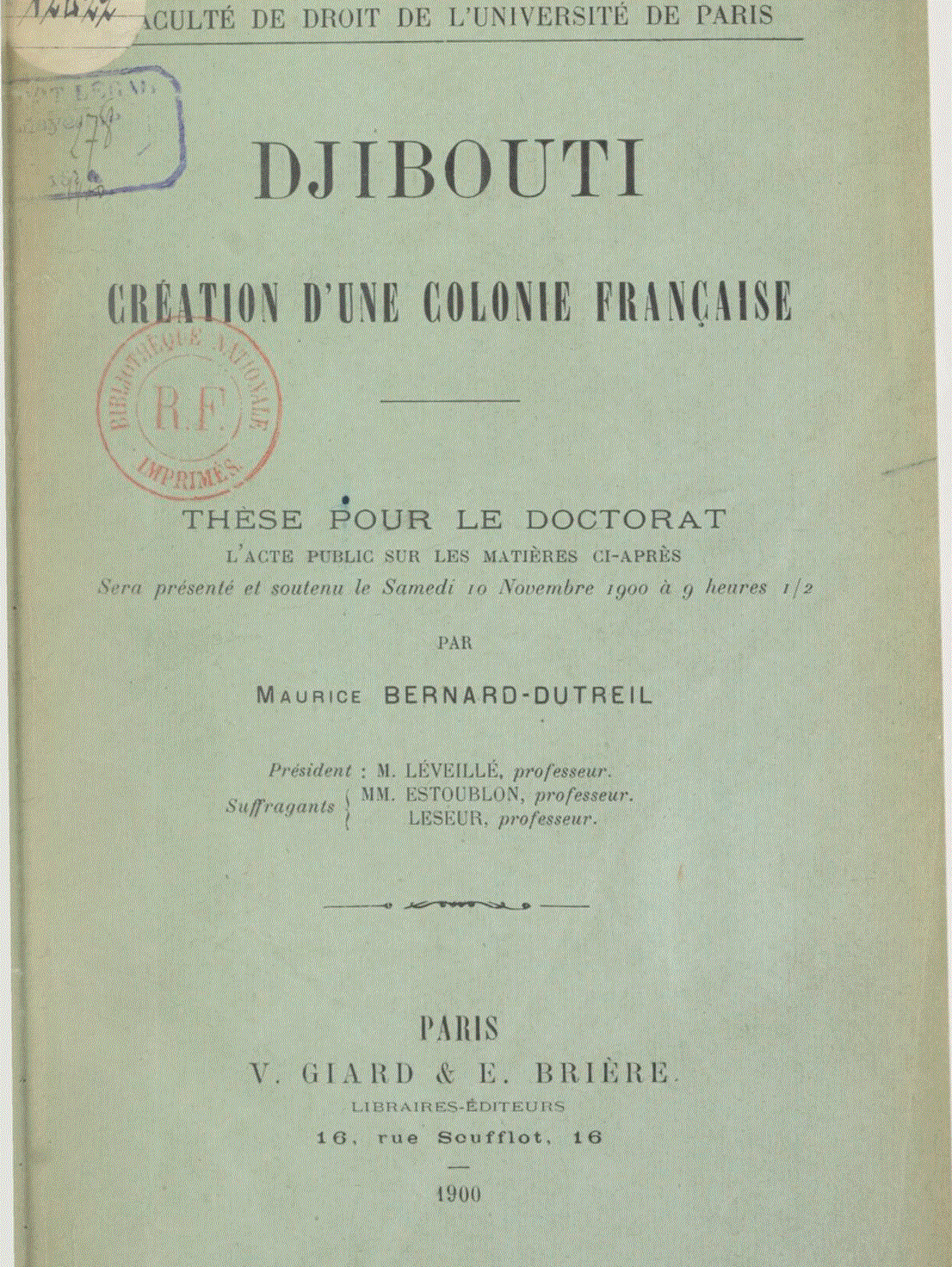
French Somaliland is Number 109 in a series of more than 160 studies produced by the section, most of which were published after the conclusion of the 1919 Paris Peace Conference. British Somaliland and Sokotra is Number 97 in the series; Italian Somaliland is Number 128. French Somaliland (present-day Djibouti) is located on the eastern coast of Africa, bordered at that time by the Italian colony of Eritrea, Abyssinia (present-day Ethiopia), and British Somaliland (part of present-day Somalia). The book contains sections on physical and political geography, political history, social and political conditions, and economic conditions. Included is a brief discussion of the population of the colony, which was comprised of two main groups, the Danakil (also known as the Afar), and the Issa Somalis. The section on political history summarizes the process by which France came to control the territory, beginning with the cession of the port of Obok by local chiefs in 1856 and ending with the conclusion of treaties of protection with the sultans of Tajura and Gobad and the chiefs of the Issa Somalis in 1884–85. The study notes that the economic value of French Somaliland derived almost entirely from its position as a transportation hub. It was the terminus of the railroad from the port of Djibouti to Ethiopia and a “convenient coaling station and port of call for vessels trading with the East, particularly with the French Asiatic possessions, and with Eastern Africa and Madagascar.” French Somaliland was renamed the Territory of the Afars and the Issas in 1967 and became independent as the Republic of Djibouti in 1977.

https://dl.wdl.org/11884/service/11884.pdf


Sunday, 17 December 2017

Isaias Afworki: Spy or a revolutionary


Isaias Afworki: Spy or a revolutionary


For years, questions have persisted over whether Isaias Afwerki was recruited during the liberation struggle—either by the CIA to infiltrate and weaken the ELF, by Ethiopian authorities under Asrate Medhin Kassa, or potentially through overlapping channels involving both, with alleged external intelligence links, particularly the Mossad.

In early November 2025, an Eritrean state media figure acknowledged for the first time that Isaias was summoned from the field to meet U.S. officials at Kagnew Station in Asmara. According to the regime’s propagandist, Awel Seid, who said, “ I want to tell you a secret today. Fighter Isaias was called from the field to Kagnew Station in Asmara to speak with American officials. The Americans asked Isaias to declare that he was fighting against Muslims, and if he did that, they would support him with all he needed.” According to Awel, Isaias refused. No one from inside Eritrea would have dared to speak about this issue without clearance from the security services.  The claims continue to fuel debate over the origins and external influences surrounding Eritrea’s armed movements. Listen to this, at the beginning of this video: https://www.facebook.com/reel/2590920941269435


A very recent confirmation (2026), came from Asrate Kassa's (Governor of Eritrea 1964 - December 1970) son, Dr. Asfeha-Wossen Asrate Medhin Kassa, in an interview with 'Arts World', confirmed that Isaias Afworki started his career in the Selfi Nasenet (later EPLF) with contacts with the CIA at Kagnew Station in Asmara and with his father, who was the Emperor's Representative and Governor in Eritrea. He also confirmed that Isaias Afeworki came to London in the early 1970s, when his father was being treated at a hospital there. He indicated that the ELF was regarded as a Muslim and Arab-oriented organisation and the new front of Isaias was regarded as Christian. He added that it was an Ethiopian policy to destroy the ELF using the EPLF (killing the thorn by a thorn.) He also stated that his father played a role so that Christian fighters in the ELF defected to Ethiopia,

Another recent confirmation (June 7, 2020) that Isaias Afworki worked for Asrate Kassa, who supplied his faction with arms. Listen from 08:50 – 16:00 minutes 

Captain Tesfaye Resteye, was a former Ethiopian police officer who served as an investigator in the security services in Asmara, Assab, and Tio in 1973 during the Haile Sellasie period. He also worked as the head of the foreign intelligence of the Ethiopian Security Services (ESS) upon return from a training course in Moscow, during the Derg period. The foreign intelligence then focussed on the Middle East and the follow-up of the Eritrean liberation movement. His last position during the Derg was the Head of the Legal Department of the ESS.

During his service in Eritrea, he was sent to investigate the army atrocities after a clash with the fighters in Baraasole in Dankalia. He narrates that he tried to calm the citizens. Tesfaye clarified his first interaction with Asrate Kassa.  When he was on his way to Assab, Asrate Kassa, who was the Governor on an army communications radio called him directly and asked him, for a briefing, At the end of their conversation, Asrate Kassa asked him to write 1000 bullets were fired. Still, Tesfaye declined to document the bullet numbers. He further stated the reason they were asking was to give the shots to the enemy to compensate for their loss.

Captian Tesfaye added, “Asrate Kassa wanted to give those bullets to the faction of Isayas Afworki.” Tesfaye added that Asrate Kassa realized that there were two factions, a Muslim and a Christian one, and he recruited Isaias to weaken the ELF, which he regarded as a Muslim movement. He adds that Asrate Kassa supplied arms to the Isaias faction and introduced Isaias Afworki to the Americans at Kangnew Station. He also stated during his investigation of fighters who were caught or defected, the defected said they joined the liberation movement to get 1500 Birr and a pistol.  Tesfaye added that Asrate Kassa used to give the defected fighters those benefits. He states that Asrate Kassa was working to depose Haile Sellasie and replace him with the Crown Prince.

He also narrates how the Derg was formed. Captain Tesfaye also explains how the Derg members were selected, the killing of the 60 high-ranking officers, and how Haile Sellasie was deposed and killed by giving him anesthesia and choking him to death.

https://www.youtube.com/watch?v=6joCaOJokzM&t=2917s


The full document, 'Isaias Spy or Revolutionary can be downloaded Herehttps://www.mediafire.com/file/hwsc7geqjc2o4io/Isaias_Afworki_Spy_or_Revolutionary.pdf/file


The following are the old and new facts:

إسياس ٱفورقي، جاسوس ٱو ثوري

نحن نحاول منذ سنوات للوصول إلى ما إذا كان إسياس أفوركي  تم تجنيده من قبل وكالة المخابرات المركزية للانضمام إلى جبهة التحرير الارترية والعمل على تفكيكها من الداخل ،'عملية زراعة البذوز' كما أشار إليها ودي جورجو و ما إذا كان قد تم تجنيده من قبل أسرىت  كاسا ــ حاكم إريتريا: ١٩٦٤ إلى  ديسمبر ١٩٧٠، نيابة عن إثيوبيا لنفس الغرض، مع الدور الضمني للموساد. إبن أسرتى كاسا المدعو ملوقيتا٬ والمقيم في لندن يؤكد ان والده كانت له علاقة بإسياس، بعلم الامبراطور وانه زاره في لندن ١٩٧٢ ـ  هناك معلومات الآن جديدة تعزز إمكانية أنه كان جاسوسا. شيء واحد نعرفه بالتأكيد، هو إن تيسفاميكئل جيورجو ٱحضر أسياس إلى أسمرة وٱخذه الي  قاعدت كاغنيوإستيشن الٱمريكية  و قد تم سجنه من قبل السلطات الإثيوبية، لذلك السبب. وكما ان داويت ولدقيوقيس يقدم معلومات عن دور المستشريين الأسرائليين في تدريب ليس فقط الجيش الاثيوبي، بل كيف حدث مرة ان تم إحضار مجموعات من الانيانيا الى آسمرة في سرية تامة وتم تدريبهم وإرسالهم للسودان

What PFDJ Ambassador Tweet 24 July, 2018 stating that Isaias struggled for this day since 1965, perhaps meaning to unite Eritrea and Ethiopia


Friday, 15 December 2017

Ethiopia General Daniel Mengistu's claim that Isaias was their spy

General Daniel Mengistu who was the Foreign Affairs security chief of Ethiopia during Haile Sellasie has stated in an interview with an Ethiopian Newspaper, in 2000 has claimed that Isaias was an Ethiopian spy and on the payroll of Ethiopia.


Friday, 8 December 2017

List of names of 19,098 mostly Eritreans who got medals for valour for service in the Italian army

 IL CORAGGIO   DEGLI ASCARI, THE COURAGE OF THE ASCARI, 2014:

List of names of 19,098 individuals mostly Eritreans who got medals for valour for service in the Italian army, by Vito Zita


እዚ መጽናዕቲ ብቅደም ተኸተል ዝርዝር አስማት እቶም ኣብ ትሕቲ መግዛእቲ ጣልያን ብውትድርና ዘገልገሉን ናይ ጅግንነት መዳልያ ዝተዓደሉን ኣስታት 19098 ሰባት የጠቃልል።


ﯾﺠﻤﻊ اﻟﺒﺤﺚ وﺑﺘﺴﻠﺴﻞ زﻣﻨﻲ –   أﺳﻤﺎء اﻟﺠﻨﻮد اﻟﺬﯾﻦ ﻗﺎﺗﻠﻮا ﺗﺤﺖ راﯾﺔ اﻟﺠﯿﺶ اﻹﯾﻄﺎﻟﻲ, واﻟﺬﯾﻦ منحو ﻣﯿﺪاﻟﯿﺎت  الشجاعة , وأﺳﺒﺎب ﺣﺼﻮﻟﮭﻢ على هذه الميداليات. وغالبيتهم من الإرتريين


Medals statistics - Gold medal for military merit: 9;  Silver medal for military merit: 2139; Bronze medal for military merit: 7185; War cross for military merit: 7560; Cross for the merit of war: 2085; Silver medal for civil merit: 6; Bronze medal for civil merit: 2; Solemn commendation: 112. Total: 19098.

Part I:

http://www.mediafire.com/file/z0qxkqhe1u741s1/Zita+book+I.pdf

Part II:

http://www.mediafire.com/file/6di4pdebqj64x1y/Zita+boo+2.pdf
---------

About the author:

VITO ZITA, the author of the book was born in 1960 in Barletta, Italy. He has lived in Siena since 1980 and has worked as a financial consultant, in financial planning and savings management. Since the end of the 1980s he has been involved in studies and research on the social and historical-military aspects of Italian colonial troops. He is a historical consultant for the colonial period at the International Museum of the World Wars, in Rocchetta Nuova IS, Italy. He is a member of the of a number of Associations including ANMIG and ANFI and ANRRA. In addition to several short essays, he published, "The courage of the Ascari - The motivations for the rewards for Military Valor for the war operations in Africa 1890-1943 assigned to the Ascari" (out of print, 2014); "The fallen of the Contrada della Chiocciola in the Great War" (out of print, 2016); "Gino Berardi, officer of colonial cavalry gold medal for Military Valor" edited by P. Angi, V. Zita, G. Zorzetto (2016); "The Colonial Cavalry from birth until 1936" (2016) also in an English version. He curated a permanent museum exhibition dedicated to the ascari at the Italian House of Asmara in November 2016. He is currently writing other works on the subject of colonial military history that will be published, soon. He is engaged in numerous conferences on the historical-military aspects, mainly colonial, which he is the  author or in collaboration with other colleagues.

Saturday, 2 December 2017

UN Resolution federating Eritrea with Ethiopia 1950

Report of the United Nations Commission for Eritrea; Report of the Interim committee of the General Assembly of the Report of the United Nations Commission for Eritrea: 


Wednesday, 29 November 2017

Old Italian videos on Eritrea starting from 1912


Old Italian videos on Eritrea from 1912


A 1912 video, on the life and times of the Eritrean Ascari:

https://www.europeana.eu/portal/it/record/08619/1037479000000254035.html?q=eritrea


1914 video: Arrival of Giovanni Cerrina Feroni, Italian Governor of Eritrea in Asmara and his visit to Keren:

http://cinestore.cinetecadibologna.it/video/dettaglio/43495

A 1929 video on sail boats from Assab, :

https://www.youtube.com/watch?v=zrXhzCX7IJU

On Dankalia 1936:

https://www.youtube.com/watch?v=aGt_sICw9II

On Dankalia, 1939:

https://www.youtube.com/watch?v=n5Ic47-H1w4

Pictures on the construction of the road between Asmara and Massawa

https://www.youtube.com/watch?v=HbXDChsqOBs

Friday, 24 November 2017

Aklilu Habte Wold's memoirs, in Amharic 1974


Aklilu Habte Wold's memoirs, in Amharic, written to the Commission of Enquiry established by the Dergue in 1974. The book was fisrt published 2010, Pages 47 - 71 cover his struggle to unite Eritrea with Ethiopia: Aklilu has served Ethiopia in various position including Foreign Minister and Prime Minister.

http://www.mediafire.com/file/u8sqd3vaho1b3ru/Aklilu+Habte+wold+memories.pdf

Sunday, 8 October 2017

Exchange of Notes between Great Britain and Ethiopia 1952


Exchange of Notes between the Government of the United Kingdom of Great Britain and Northern Ireland and the Government of Ethiopia regarding the Federation of Eritrea with Ethiopia under the sovereignty of the Ethiopian Crown Addis Ababa, August 27/29, 1952

http://treaties.fco.gov.uk/docs/pdf/1954/TS0022.pdf

L’IMMAGINE DELL’ERITREA NELLE FOTOGRAFIE DI ERRARDO DI AICHELBURG (1898-1903) CONOSCENZA E DOMINIO


L’IMMAGINE DELL’ERITREA NELLE FOTOGRAFIE DI ERRARDO DI AICHELBURG (1898-1903) CONOSCENZA E DOMINIO

THE IMAGE OF ERITREA IN ACHELBURG ERRARDO PHOTOGRAPHS (1898-1903) KNOWLEDGE AND DOMAIN

http://www.mediafire.com/file/6l28gza3a8b2yge/L%E2%80%99IMMAGINE+DELL%E2%80%99ERITREA+NELLE+FOTOGRAFIE+DI.pdf

Wednesday, 4 October 2017

Wednesday, 30 August 2017

ሓምሸይቲ ወተሃደራዊ ክፍሊ ተሓኤ The 5th Military Zone of the ELF


ሓምሸይቲ ወተሃደራዊ ክፍሊ ተሓኤ: አቓቅማ ሽግራትን ምስላማትን ምቅተልትን ሳዕቤትን


http://www.mediafire.com/file/h2o07hj8m4m9f3f/Hamshaiti+Kifli_ELF+5th+Zone.pdf

ምንጪ : ካብ ኣብዚ ቀረባ ዝወጸ መጽናዕታዊ ጽሑፍ

Friday, 18 August 2017

Monday, 14 August 2017

الإلمام بٱخبار من بٱرض الحبشة من ملوك الإسلام


الإلمام بٱخبار من بٱرض الحبشة من ملوك الإسلام

بقلم تقى الدين أحمد بن على بن عبد القادر بن محمد المقريزي
توفى المغريزي في ٨٤٥ه الموافق ١٤٤٦
http://www.mediafire.com/file/c7z8ig9fgmmzszo/Magrizi+Habesha.pdf

Taqi al-Din Abu al-Abbas Ahmad ibn 'Ali ibn 'Abd al-Qadir ibn Muhammad al-Maqrizi (1364–1446) was an Egyptian historian more commonly known as al-Maqrizi or Makrizi. This is one of his books, on Muslim kings in Abyssinia 

Sunday, 6 August 2017

The Kunama and their marriage customs


Kunama marriage customs, a note written in 1966/67 by M. Cittadini, H. S. I. University, Addis Ababa

http://www.mediafire.com/file/bpyfadaw3ovntcj/Kunama+marriage+customs+1966.pdf

Thanks to Prof. Kjetil Tronvoll for sharing