Saturday, 29 February 2020
Tigrinya Applicatives in Lexical-Functional Grammar by Nazareth Amlesom
Tigrinya Applicatives in Lexical-Functional Grammar, a 2011 PhD Thesis by Nazareth Amlesom, Department of Linguistic, Literary and Aesthetic Studies University of Bergen
Part of the Abstract:
The primary goal of this thesis is to describe and analyze applicative constructions in Tigrinya. An applicative construction is characterized by a verb that bears an affix for an argument that either has a semantic role that is not normally entailed by the lexical meaning of the base verb or is specified as a peripheral argument. The choice of an applicative expression is motivated by semantic and discourse factors. Applicatively expressed arguments are associated with referents that possess high semantic prominence and discourse salience. The applicative phenomenon is viewed as a morphosyntactic strategy that introduces a core object function that is salient in the discourse event described by the verb. The theoretical motivation of this study is to explore the conditions that trigger object marking in Tigrinya so as to examine the semantic, functional and discourse properties of objects. The main theoretical framework used in this research is Lexical-Functional Grammar (LFG). This formalism assumes that the different linguistic information pertaining to functional, semantic and discourse structures can be modeled as interrelated parallel representations.
https://bora.uib.no/bitstream/handle/1956/5730/42478%20Nazareth%20Kifle%20materie.pdf?sequence=1&isAllowed=y

Saturday, 15 February 2020
IOM WORLD MIGRATION REPORT 2020
IOM WORLD MIGRATION
REPORT 2020
Eritrea is the only country in Africa that has no civil strife, but yet produces the largest number of refugees

https://publications.iom.int/system/files/pdf/wmr_2020.pdf
Sunday, 19 January 2020
Eritrea: Miscellaneous historical Documents from the 40s & 50s
Eritrea: Miscellaneous historical Documents from the 40s & 50s


British Statistics on Casualties due to Shifta activities and casualties inflicted on them
1948 - April 1950

Police Commissioner authorizing the flying of the Muslim League flag 1951


Saturday, 28 December 2019
Animal Diseases and Veterinary Services in Eritrea 2001
Animal Diseases and Veterinary Services in Eritrea: The Past, Present and Future Challenges
Mohamed Kheir Omer, Gebrehiwet
Taeme and Andom Gebremeskel
A paper presented at the Eritrean Studies Association Conference held at Asmara, Eritrea
June 2001
Can be downloaded at the link below:
http://www.mediafire.com/file/fipdne3jy4bo9x6/Veterinary_Services_2001.pdf/file
Thursday, 26 December 2019
Refugees and citizens: Understanding Eritrean refugees’ ambivalence towards homeland politics
Refugees and citizens:
Understanding Eritrean
refugees’ ambivalence towards
homeland politics, a 2019 article by Milena Belloni, University of Antwerp, Belgium
Abstract
This article revisits ambivalence as a protracted state which does not simply develop as a result of the migration experience but stems from overlapping levels of normative inconsistency. Drawing from my ethnography of Eritreans’ everyday life in the homeland and abroad, I analyse their attitudes of patriotism and disenchantment through an ambivalence lens. Their ambiguous attitudes are arising from national and transnational Eritrean state policies and are further complicated by their role as “political refugees” in host countries. My informants’ ambivalence stems from them embodying more than one role (i.e. patriots, family breadwinners, refugees from and citizens of their homeland), from contradictory expectations pertaining to the same role (i.e. young citizens in Eritrea) and from clashing implications of being members of two different social systems (i.e. the destination country and the country of origin). Thus, Eritreans’ political loyalties and actions are characterized by a state of ambivalence throughout their migration process. Despite its peculiar characteristics, this case study sheds light on the complexity of ambivalence, as more than a temporary condition, for migrants and refugees in particular. In the current scenario of emigrant states’ transnational governance, protracted ambivalence is likely to mark the attitudes of an increasing number of people on the move as both refugees from and citizens of their country of origin.
You can access the full text at the link:
https://journals.sagepub.com/doi/pdf/10.1177/0020715218760382
Abstract
This article revisits ambivalence as a protracted state which does not simply develop as a result of the migration experience but stems from overlapping levels of normative inconsistency. Drawing from my ethnography of Eritreans’ everyday life in the homeland and abroad, I analyse their attitudes of patriotism and disenchantment through an ambivalence lens. Their ambiguous attitudes are arising from national and transnational Eritrean state policies and are further complicated by their role as “political refugees” in host countries. My informants’ ambivalence stems from them embodying more than one role (i.e. patriots, family breadwinners, refugees from and citizens of their homeland), from contradictory expectations pertaining to the same role (i.e. young citizens in Eritrea) and from clashing implications of being members of two different social systems (i.e. the destination country and the country of origin). Thus, Eritreans’ political loyalties and actions are characterized by a state of ambivalence throughout their migration process. Despite its peculiar characteristics, this case study sheds light on the complexity of ambivalence, as more than a temporary condition, for migrants and refugees in particular. In the current scenario of emigrant states’ transnational governance, protracted ambivalence is likely to mark the attitudes of an increasing number of people on the move as both refugees from and citizens of their country of origin.
You can access the full text at the link:
https://journals.sagepub.com/doi/pdf/10.1177/0020715218760382
Monday, 23 December 2019
Introducing Haji Jaber's award winning Arabic novels
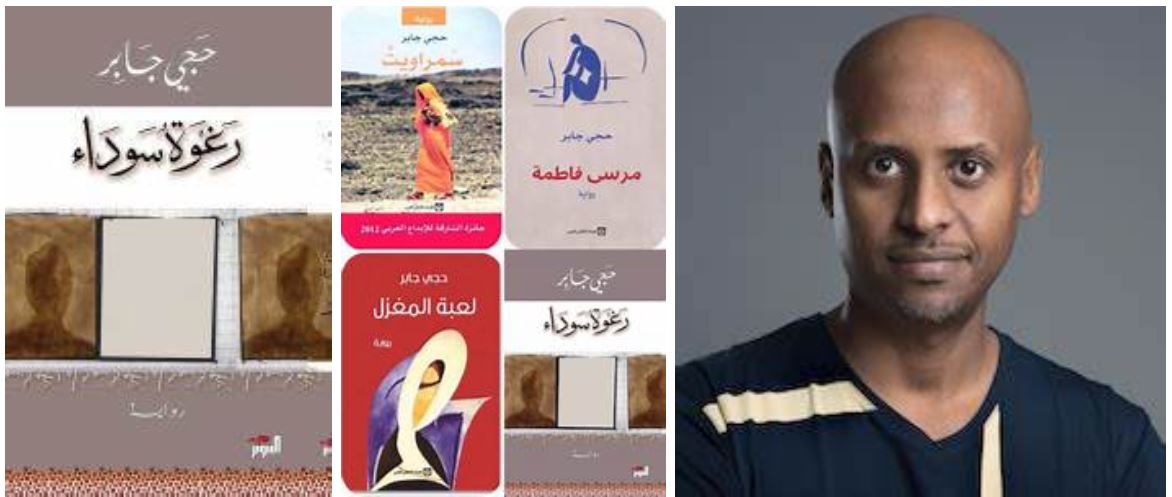
Haji Jaber is an Eritrean novelist, born in the coastal city
of Massawa in 1976. He escaped with his family to Jeddah while he was breast
feeding, to escape Ethiopian atrocities. He grew up and studied in Jeddah. As
an immigrant in Saudi Arabia it was difficult for his family to find him a
school but at last, he was able to get private education. He has published so
far four novels: Samrawit (2012), winner of the Sharjah Award for Arab
Creativity in 2012, Fatma's Harbour (2013), The Game of the Spindle (2015),
which was longlisted for the 2016 Sheikh Zayed Book Award, and Black Foam (2018)
which won the prestigious ‘Katara Prize’ In the category of the published Arabic
novel. Eritrea is vividly present in his novels.
Samrawit (2012) is about discovering Eritrea after a long
immigrant life in Jeddah, it is about the author’s or at times the main
character’s first his interaction with the Eritrean Embassy there. It was about
‘home coming’. His first emotion-laden travel to Asmara and Massawa. Though the
author had no personal memories about Eritrea, his collective memories are rich
taken from his family who talked about the country daily. His mother’s longing
to Zewditu, her close friend in Massawa. The main character falls in love with
an Eritrean girl, Samrawit who lives abroad but was visiting Eritrea the same
time he was there, he is being a Muslim and she being a Christian had its
challenges. Samrawit is about this journey.
His second novel, Fatma's Harbour (2013) is about the main
character from Ghinda who lives in Asmara and falls in love with a secondary
school student who fails her exams deliberately to avoid Sawa and who lives at
the old street of ‘Mersa Fatma’ meaning Fatma’s harbour. The street is close to
Enda Mariam. Through the main character, the author takes us to youth life in
Asmara, the Asmara University refusal to go to Kemtawi Maatot in 2001, the
measures taken by Eritrean government, life in the national service in Sawa, the
kidnapping by the Rashaida (what the author calls the Shifta), life in Shegerb refugee
camp in Sudan with its old refugees of the 1960s and the new one. All those
events are beautifully narrated in the journey of the main character in search
for his lover. The novel
His third novel, The Game of the Spindle, centers around the main character, who is a
charming girl who had lost her both parents in the struggle and who lives with her
grandmother who excels in spinning yarn and telling stories. The story centers
in the newly formed Archives Department, where the charming girl is employed.
The archives department aim is to digitalize documents written by fighters during
the liberation. The folders are marked by three colors, BROWN which are
considered public, YELLOW which are regarded semi-confidential and RED which
are strictly confidential. People are recruited to this department after a lot
of scrutiny. The beginners are given only the BROWN files and as their loyalty is
tested their gradually deal with the confidential files. The main character
starts with the BROWN ones, but quickly finds them boring and uses her beauty
to get to the RED files. The Red files
get edited by the president of the state. She starts manipulating the stories
in the files, re-writing them as she would tell the story. It is in those RED
files she discovers a stunning history about her parents and about the
President.
Black Foam follows a group of Ethiopian Jews, the “Falash
Mura”, who are driven by poverty and desperation, emigrate to Israel in search
of a better life. Amongest them is Dawoud, who changed his name to “Dawit” so
that western NGOs can take him to Europe but fails. Upon learning that Falasha Jews
are being transported to Israel, he invents a new identity, changing his name
and history, so that he can travel to Israel alongside the Falasha Jews.
However, on arrival, he faces the trials and suffering experienced by
dark-skinned immigrants in the country.
Saturday, 30 November 2019
Tigre (Tigrait) Studies in the 21st Century
Tigre (Tigrait) Studies in the 21st Century; A 2015 book with 241 pages:


The book can be downloaded here; https://www.mediafire.com/file/48er96shz1vqpbv/Tigre+in+21st+century.pdf/file
Tigre Studies in the 21st Century: A Review of the book;, RAINER VOIGT, ed. / Tigre-Studien im 21. Jahrhundert, Studien zum Horn von Afrika, 2 (Köln: Rüdiger Köppe, 2015). xi, 241 p
At the 3rd International Enno Littmann Conference held at the Freie Universität in Berlin
On April 1–4, 2009, under the heading "Tigre, Aksum, and More," a special panel was devoted to the Tigre language and literature, as well as Tigre society. The present volume, carefully edited by Rainer Voigt, who also organized the conference, contains the papers presented on this panel, in which scholars from Eritrea actively participated. It is doubtless to their presence that we owe a refreshing first in Ethiopian and Eritrean studies, namely, abstracts of the articles also in Tigre. This language is described by the editor in the Introduction as the third largest Ethiopic-Semitic language after Amharic and Tigriñña; this is true only if we adopt the new trend in Ethiopian studies, and consider what used to be the Gurage dialect cluster with nearly 3,000,000 speakers or more, as a distinct group of several separate languages.
https://journals.sub.uni-hamburg.de/aethiopica/article/view/978/1000
The book: https://www.koeppe.de/titel_tigre-studies-in-the-21st-century-tigre-studien-im-21-jahrhundert
--------------------------
Thanks to Suleiman Bekit for sharing
Thursday, 7 November 2019
Eritrea - Ethiopia Boundary Commission DECISION Regarding Delimitation of the Border
Eritrea - Ethiopia Boundary Commission DECISION Regarding Delimitation of the Border between The State of Eritrea and The Federal Democratic Republic of Ethiopia
http://www.eritrea.be/EEBC_decisions_2002.pdf
Wednesday, 6 November 2019
Aspects of Tigrinya Literature until 1974
Aspects of Tigrinya Literature (until 1974) by Hailu Habtu, a M.Phil. thesis, School of Oriental and African Studies, University of London, 1981
ABSTRACT
This dissertation aims to study the origin and development of Tigrinya as a written language-a topic that has so far received little scholarly attention. As time and the easy accessibility of all the relevant material are limiting factors,this investigation is necessarily selective. Chapter One takes stock of all available writing in the Tigrinya language frcm its beginning in the middle of the last century up to 1974. Chapter Two briefly investigates the development of written Tigrinya to serve varying functions and ends and the general direction that its development took. Chapter Three provides a glimpse of the breadth and variety of literature incorporated in the Eritrean Weekly News published in Asmara by the British Information Services frcm 1942 to 1952. The E W N represented the sudden birth and development of a secular writing and provided a tradition and a reservoir of literature on which Tigrinya fiction later drew. Chapters Four, Five and Six deal with Tigrinya fictional literature on the basis of selected themes v. g. historical and political themes (Chapter Four), prostitution and approbation against dissolute life (Chapter Five), and education and success (Chapter Six)
https://eprints.soas.ac.uk/28848/1/10673017.pdf?fbclid=IwAR1KCJ2H3u34s6EzFSsaHI_eiHn07ihprNxviuPMWKHtgWkV9wkdEjKu-f4
Wednesday, 23 October 2019
Naud's Novel 'SALEH' - رواية محمد سعيد ناود، صالح
رواية محمد سعيد ناود، صالح

http://www.mediafire.com/file/b5vx8dl0cw9kkqw/Naud_novel_%25D8%25B1%25D8%25AD%25D9%2584%25D8%25A9_%25D8%25A7%25D9%2584%25D8%25B4%25D8%25AA%25D8%25A7%25D8%25A1.pdf/file
Thanks to Ibrahim Idris, Adal House for sharing
Thursday, 29 August 2019
Günter Schröder on what is the real population in Eritrea and why it is kept as confidential
Günter Schröder on what is the real population in Eritrea and why it is kept as confidential:
https://www.youtube.com/watch?v=eK0ZBDxHiS8&feature=youtu.be
Monday, 26 August 2019
How Eritrea's regime policies causing large scale exodus of mainly young men impact on gender distribution and population growth in the country
How Eritrea's regime policies causing large scale exodus of mainly young men impact on gender distribution and
population growth in the country

Watch the video:
Eritrea regime's social engineering impact on ethno-demographic balance of population
Eritrea regime's social engineering impact on ethno-demographic balance of population

https://www.youtube.com/watch?v=iicCCe90HHs
Friday, 9 August 2019
Asmara Pictorial Book 1890-1938 Print and ebook in Italian English Arabic Tigrinya
ASMARA
From 4 villages to a UNESCO’s World Heritage Site
أسمرة
من ٤ قرى صغيرة لـ" قائمة التراث العالمى"
لليونسكو
ኣስመራ

From 4 villages to a UNESCO World Heritage Site This is the first part of pictorial books about Asmara, the capital of Eritrea, covering the period 1890 -1938. On the 8th of July, 2017, Asmara was included in the UNESCO’s World Heritage Sites. UNESCO, described Asmara as a Modernist City of Africa and added, “Located at over 2,000 m above sea level, the capital of Eritrea developed from the 1890s onwards as a military outpost for the Italian colonial power. After 1935, Asmara underwent a large scale programme of construction applying the Italian rationalist idiom of the time to governmental edifices, residential and commercial buildings, churches, mosques, synagogues, cinemas, hotels, etc.” This pictorial book takes you through that journey on how Asmara developed from four villages to a modernist city, with explanatory captions in Italian, English Arabic and Tigrinya.
SBS Tigrinya interview with the authors:
"ኣስመራ፡ ካብ ኣርባዕተ ዓድታት ናብ ቦታ ቅርስታት ዓለም" ዕላል መጽሓፍ ምስ ዶ/ር መሓመድ፡ ኣቶ ነጋሽን ኣቶ ጀላልን
https://www.sbs.com.au/language/tigrinya/audio/aasemaraa-kaabe-aarebaaeta-aadetaate-naabe-botaa-qeresetaate-aalame-elaale-matsehhaafe?fbclid=IwAR3rmXaM6ZV0TmBCvgSfCrWqn4EfJjC2TNWy4aQFWPHcH_YLVDgzzkRIcZk
=========================
A summary of book promotion with Asmara Shuker music:
https://www.youtube.com/watch?v=P5SzubOBk4U&t=27s
--------------------------------------------------------------------------
The book is available at:
https://www.lulu.com/shop/search.ep?keyWords=Asmara%3A+Pictorial+Book+1890+-+1938&type=
Characteristics of typical African elections
Characteristics of typical African elections:
- There is lack of transparency in the process of elections
- The incumbent President has a better chance of cheating
- The loser does not acknowledge defeat even if the country is on fire
- Some times one can never make it to the presidency if one has a smaller social base, as people are more liable to elect persons from their own social base, but for some the only goal in life is to be a president, all or none
- The opposition wants to rule, in the first free elections, instead of building up on their achievements and prepare for the next elections
Sunday, 4 August 2019
RIVALRY, ANTAGONISM AND WAR IN THE NATION- & STATE-BUILDING PROCESS
RIVALRY, ANTAGONISM AND WAR IN THE NATION- & STATE-BUILDING PROCESS: THE H FACTOR IN THE RELATIONS BETWEEN ERITREA AND ETHIOPIA, an article by Uoldelul Chelati Dirar
Märäb Mällaš is defi nitely the toponym which has enjoyed the
greatest favour thanks also to the homonymous title of Perini’s book. However,
the very adoption of those two toponyms speak volumes about dominant
perceptions of land and polities. In fact both denominations and particularly
Märäb Mällaš refl ects a geographical position which betrays the location of the
observant and, therefore his/her perception of space and power relations from a
perspective strongly infl uenced by the Ethiopian polity taken as a main
reference and Təgrəñña and or Amharic languages as main medium of
communication. I wonder if this representation of space and polities would
equally satisfy an Afar, Təgre, Kunama, Nara or Beni Amer speaker. Would it
accommodate his/her perception of spatial and political hierarchies? It seems
to me that dominant narratives on Eritrea and on Eritrean-Ethiopian relations
implicitly assume Eritrean Təgrəñña-speaking highlanders as their main object
and by so doing tend to fall in the common mistake of confusing the part for
the whole. Until now historiographic analyses of pre-colonial balances of power
in the region have failed in taking into adequate consideration narratives from
the Western lowlands and, to a certain extent, also those from the Eastern
lowlands of what is today the State of Eritrea. They have remained marginal
both in colonial and post-colonial literature.
https://u-pad.unimc.it/retrieve/handle/11393/41720/958/Uoldelul_Rivalry%20Antagonism%20and%20War.pdf
Thursday, 1 August 2019
Human Rights in Eritrea 1955
Human Rights in Eritrea 1955, Modern Law Review 1955 Vol 18, pp. 484-486, article by Clarence Smith
The idea of the citizen having any rights against the authorities being a startling innovation in Eritrea, resort to the Supreme Court in defence of constitutional rights has been rare, but five cases have arisen in the first two and a half years of self-government. The earliest case, decided in August, 1953, concerned the “right to freedom of opinion and expression,” a newspaper having been suppressed by the withdrawal of its licence to print just before the persons concerned had been acquitted of a criminal charge of seditious libel. Under an Italian law no one could print without a licence, and the court held that this provision was constitutional as a means of raising revenue and of keeping the authorities informed of the existence and locality of printing presses; but that it was unconstitutional as a means of controlling the press, and that the withdrawal of the licence for this purpose was therefore unlawful.
https://onlinelibrary.wiley.com/doi/epdf/10.1111/j.1468-2230.1955.tb00316.x
------------------------------------------------------
Thanks to Prof. Kjetil Tronvoll for making me aware of the article
The idea of the citizen having any rights against the authorities being a startling innovation in Eritrea, resort to the Supreme Court in defence of constitutional rights has been rare, but five cases have arisen in the first two and a half years of self-government. The earliest case, decided in August, 1953, concerned the “right to freedom of opinion and expression,” a newspaper having been suppressed by the withdrawal of its licence to print just before the persons concerned had been acquitted of a criminal charge of seditious libel. Under an Italian law no one could print without a licence, and the court held that this provision was constitutional as a means of raising revenue and of keeping the authorities informed of the existence and locality of printing presses; but that it was unconstitutional as a means of controlling the press, and that the withdrawal of the licence for this purpose was therefore unlawful.
https://onlinelibrary.wiley.com/doi/epdf/10.1111/j.1468-2230.1955.tb00316.x
------------------------------------------------------
Thanks to Prof. Kjetil Tronvoll for making me aware of the article
Saturday, 20 July 2019
Jeberti Women Traders’Innumeracy
Jeberti Women Traders’Innumeracy, Its Impact on Commercial Activity
in Eritrea, a 2009 artcle by Abbebe Kifleyesus
Throughout the last millennium the Muslim Jeberti traders of Eritrea played a critical role in linking the diverse reaches of the plateau districts of Hamasien, Seraye and Akkele Guzay (Zoba Debub in present day Eritrea) to carry their goods and, in the process, ideas and news from one region to another. As the Red Sea trade increased in volume and momentum in the late xviiith and xixth centuries, the Jeberti confronted commercial competition from coastal peoples. Yet the Jeberti who at present represent some seven percent of the Tigrigna population of Eritrea have as Muslims always felt a divine mandate to be merchants and have traditionally posited a high institutional affinity for commercial undertaking using folk systems of numbering as a means for achieving upward mobility, social respect and upholding family economic benefits.
https://journals.openedition.org/lhomme/21986
---------
Thanks to Jelal Yassin for sharing
Friday, 12 July 2019
Dr. Hashim A-Shami: On the Afar roots of martyr Abdulgader Mohamed Saleh Kebire
Dr. Hashim A-Shami:
On the Afar roots of martyr Abdulgader Mohamed Saleh Kebire
I asked Dr. Hashim Jamal al-Din A-Shami (widely known as Hashim A-Shami
*) about the links of late Eritrean politician, martyr Abdulgader
Kebire to the Afar and he wrote this note hastily in Arabic and below is a translation of
his note, in English. Any mistakes in translation, mine.
"The great and veteran politician,
martyr Abdulgadir Mohamed Saleh Kebire, is of Afar-Jeberti origins[1] and
was born on Dese island, which is part of the Afar region within the
Buri Peninsula. His mother, Fatima Kebir was from the Dahimela tribe. His
brother, Ibrahim, lived and was buried in the Qenfur area, near Dese island.
Kebire married Zeinab Ishaq Adam from the tribe of Sheikh Adamtu (son of
Sheikh Adem). The uncles of his wife are from the tribe of Qaas Sambo. One
of Abdulgadir’s sisters, Aisha Kebri was married to Ibrahim from the tribe of
Kifertu. His second sister, Madina was married to Rashid Abdu from the 'Ante li Sheikh Ali' tribe It should be noted that his mother Fatima and his
sisters, Aisha and Madina died in and were buried in the village of Adai le
Dora Dese Peninsula.
There is no doubt that Mr. Abdulgadir Kebire
also lived in among the Jeberti in Asmara where he practiced his political and daily
life and had children from his Jeberti wife. The influence of the Jeberti
community was very important in the formation of his personality, development
and the special social status he achieved. It is worthy to note that the Afar,
and the Jeberti in general and Argobba (Arab Jebey) had important historical relations
in the Sultanate of IFAT. The Ifat Sultanate was dependent on the Emirate of
Adal which was in part of the Afar region. The center of the Sultanate of IFAT was
in the city of 'Dawe', which is currently part of the Afar region in Ethiopia.
It was the hub and zone of influence of the Emirate of Bodaye. Amir Mohamed
Bodaye had authority over the city of ‘Dawe’ in the 19th and 20th
century and it was the core of his Dahimele tribe.
The jeberti are originally, from the land
of IFAT. According to Ibn Saeed, who lived 1214 – 1287 AD, IFAT was also known
as the land of the Jeberti (Jeberta)[2]
and he stated, “It has a Muslim king and the inhabitants are Muslims from
different ethnic groups and IFAT city lies on higher ground.”
Even the historian, Al-Mughrizi pointed
that the Welashma family that claims to be from Arabian roots from Al-
Hijaz, had settled in the land of al-Jabr (Jeberta)[3].
The great
Italian historian, E. Cerulli[4],
obtained, during the occupation of Ethiopia by Italy, a document written in Arabic
that clearly indicates that there was a Makhzoumi Sultanate in East of
Shoa established in 283 according to the Hijra calender corresponding to
896/897 AD and it was destroyed due to internal conflicts and in addition to
the invasion of Ali Ibn Waliasma in 1277 AD.
As is well-known to all, Beni Makhzoum
is a very famous Mekka tribe, where the great Muslim military leader, Khalid
Bin Al Waleed belonged to. The Beni Makhzoum were at odds with Beni
Umiah. It is believed that an important part of this tribe migrated to
Abyssinia during the Islamic rule of caliph Omar Bin Al Khattab. Thus, one can
say, in brief, that the Jeberti are of Arab origin who lived in east Shoa, and
especially around the IFAT. As has been stated above the Sultanate of IFAT, had
different ethnic groups within it (Afar, Jeberti and Argobba).
In addition to that, the Jeberti had very
important contributions to safeguard Islam and to raise its status in Gondar, Tigray,
Seraye and Hamassein (Asmara). Due to that, the name Jeberti became
tied to Islam such that the Islamic institution, Al Azhar established centuries ago,
a special gallery (learning unit) for students from Abyssinia, known as the Jeberta
gallery (riwag al jeberta).
The Jeberti, particulary in Seraye and
Asmara were dynamic and active in the commercial, cultural, scientific and
political fields in Eritrea in the period from 1942 to 1952. They played also
big role the preservation and practice of moderate Islam, which believes and
calls for moderation and coexistence among the national components, Muslims and
non-Muslims. The Grand mufti, Sheikh Ibrahim Mokhtar, a graduate of Al Azhar
University, played also a big role in this regard with his reformist directives.
In addition to that, the presence of families and members of the Jeberti
community, such as the families of Aberra,
Hagos, and Khairallah and others played an important role, too. Among
the individuals, to name a few were Berhanu Ahmeddin, the veteran and
courageous politician, as well as the writer and intellectual, Mahmoud Noor
Hussain.
Mahmoud may have been one of the most prominent
intellectuals of his time. He was fluent in Italian, Arabic and English
languages, and his books in Arabic history and language, including translations
of some publications from English and Italian to Arabic and vice versa, was a
great contribution. I thus urge for the works of Mahmoud Nour Hussein be
published. Thus, the Jeberti activity was not limited to trade, as some
components of Eritreans, fond of stereotypes want to portray them. This
reflects their shallow understanding of the Jeberti. Some components do this to
undermine or do injustice to others.
Abdulgadir Kebire was also married to a
Yemeni woman and had children from her. Abdulgadir’s son, Saleh Abdulgadir kebire was an intellectual.
He graduated from the American University in Beirut. He was aware of his Afar
roots and had close and daily contacts with many of the Afar, while he was the
Mayor of Massawa and during his long stay in Addis Ababa, where he practised as
a lawyer and later became the Chair of the Ethiopian Lawyers’ Association. During
his stay in Massawa and Asmara, he was in contact with his relatives in the Buri
Peninsula, especially with his aunt Aisha, who used to visit the family of
Abdulgadir Kebire in Asmara. Saleh Kebire died in March 2000 and was buried in
Addis Ababa.
It is known that the leader Abdulgadir
Kebire was a friend of several Afar dignitaries, including, among others,
Sheikh Yassin Mahamodah Qahmed, Sheikh Musa Qaas Mohamed, Sheikh Jamal al-Din
Ibrahim Khalil al-Shami, Sheikh Siraj Mohamed Kamel, Haj Mohamed Osman Houri
and Sheikh Rashid Ismail Hamid Hassen. Sheikh Siraj Mohamed Kamel was one of the
closest friends of Abdulgadir. When World War II broke out, Abdulgadir sent his
elder son, Saleh, to Dahlak to study with the family of Sheikh Siraj Mohammed
Kamel and under his supervision. Saleh returned to Asmara after the British
occupation and the end of the war.
I would like to reiterate again about the
importance of the Jebrti’s community in Asmara in the formation and development
of the personality of the leader Abdulgadir. There is no doubt that Abdulgadir
had all the characteristics of leadership, knowledge and a solid will. He was
an intellectual who was loyal to his principles.
To sum up what is important is not a
personal affiliation of an individual to a particular tribe or a social
component, but what matters most is a person’s achievement to his country and endeavours
to raise the value of humanity in general and efforts in achieving freedom and
social justice.
On the other hand, it is very important,
but not the most important for me (Hashim Jamal al-Din A-Shami) to answer the
question by Dr. Mohamed Kheir Omer. It is the right of researchers and citizens
to know the background of a public person, particularly about leaders and the
people who left their distinguished marks on a particular region or country. “
Signature
Hashim Jamal al-Din A-Shami
*Hashim Gamaluddin Ibrahim Al-Shami, holds a doctorate degree in Economics from the University of University of Wisconsin - Madison, USA. He is interested in the history and studies of East Africa and Southern Arabian Peninsula. He is a co-author (the other author was his father, Sheikh Gamaluddin Ibrahim Al-Shami) of the book on the History of the Afar, in Arabic that was issued in 1991, and the second edition was published in 1996. The book is in about 750 pages. His father wrote 182 pages of the book. The book was translated to Amharic, with additions to the Arabic version in 2007 with the title (ዓፋር (ደንከል) ታሪክና መረጃ አርክ ምንጭ). The book was recently translated to English.
[3] المغريزي: أحمد بن علي بن
عبدالقادر بن محمد المغريزي " كتاب الألمام بأخبارمن تأريخ ارض الحبشة من
ملوك الأسلام", مطبعة التأليف بمصر
Friday, 21 June 2019
A Preliminary Conservation and Development Scheme for Old Massawa: UNESCO 1998
A Preliminary Conservation and Development Scheme for Old Massawa (Eritrea's Oldest Living town) by Ann Pulver and Arnaud Goujon, UNESCO 1998
According to the document, the town is situated on two coral islands, Massawa and Taulud. A detailed map of the town in 1885 records 5000 inhabitants, 216 masonry houses, 233 huts, 3 main mosques with minarates, 10 secondary mosques, and 22 Arab and European Cafes. In 1888 part of the town was destroyed by fire and on 14 August 1921 most of the town was destroyed by an earthquake.

www.mediafire.com/file/76lgbcyksbscxw5/UNESCO+development+scheme+for+Massawa.pdf
Subscribe to:
Posts (Atom)