A treasure trove: Some 90 historical books and documents on Sudan
Saturday, 16 July 2022

The Rise of Political parties in Sudan 1936 - 1946 PhD Thesis
The Rise of Political parties in Sudan 1936 - 1946 a PhD thesis by Alexander Solon Cudsi
Can be downloaded at https://eprints.soas.ac.uk/28607/1/10672766.pdf
Or at
https://www.mediafire.com/file/47w88xxro6z315u/Sudan+RISE+OF+POLITICAL+PARTIES+1936+to+1946.pdf/file
Saturday, 18 June 2022
A 2019 PhD Thesis: MODELING THE LOCAL POLITICAL ECONOMY OF ADULIS: 1000 BCE – 700 ACE
MODELING THE LOCAL POLITICAL ECONOMY OF ADULIS: 1000 BCE – 700 ACE
A 2019 PhD Thesis DANIEL T. HABTEMICHAEL Submitted to the Graduate School of the University of Massachusetts Amherst in partial fulfillment of the requirements for the degree of DOCTOR OF PHILOSOPHY
https://www.academia.edu/81479533/Modeling_the_Local_Political_Economy_of_Adulis_1000_BCE_700_ACE
Two political economy models are used to critically evaluate the energetics data from the built-forms combined to another set of data of essential artifacts from the site. The traditional political economy perspective holds that Adulis is a periphery, a port in an Aksum dominated world economy. An alternative theoretical position proposed in this dissertation is that Adulis was an independent state and a center of its own.
The dissertation research shows the archaeological data supports that Adulis
was a center of its own. Moreover, the dissertation successfully establishes
the basis of Adulis' political economy by distinctly illustrating its role in
interregional trades in aromatics, readiness to train and export war elephants,
and its perceived upper-tier rank in governance locally and among other Red Sea
ports. Early involvement of Adulis in the aromatics trades of the Red Sea
instituted tangible and intangible political economy capital. However, it was a
combination of Adulis’ capability to export war elephants in wars of local and
general interest, its strategic location connecting the Mediterranean and the
Indian Ocean worlds, responsible governance, and its favorable climatic conditions
all were factors in Adulis’ significant position in antiquity.
Friday, 17 June 2022
A Portrait: Isaias Afwerki, The Man & The Dictator
A Portrait: Isaias Afwerki, The Man & The Dictator
Following a series of interviews with former colleagues, this is an attempt to profile one of Africa’s most reclusive and authoritarian leaders. Though he remarkably outlasted his peers, his unwillingness to change is now detrimental to his country and its neighbours.
https://democracyinafrica.org/a-portrait-isaias-afworki-the-man-the-dictator/
A Portrait: Isaias Afworki, The
Man & The Dictator
11.04.2022 published at Democracyinafrica.com
Faisal Ali, Mohamed Kheir Omer
Following a series of
interviews with former colleagues, this is an attempt to
profile one of Africa's most reclusive and
authoritarian leaders. Though he remarkably outlasted his peers, his
willingness to change is now detrimental to his country and its neighbours.
Isaias Afwerki has never faced an election in
the three decades he's led his country. He tends not to mince words about why
this is the case. Isaias cannot stand to take a mandate from the people as that
will limit his powers. He believes his stewardship is necessary to safeguard
the integrity of the young republic he believes he steered to independence. He
doesn't do it for fun or glory, as he explained in a rare personal interview
in 1996. Isaias said he "dislikes" politics but views it as a sacred
"duty." "Whenever justice is missing in a society, it always
grates on you," he said.
This calling, he explained, has come at a
tremendous personal sacrifice, forcing him to put aside his own personal,
artistic and literary pursuits to lead his nation. "I do not like the life
of a politician," he continued, "I don't even like to live like a
president." Given that's the way he feels, it should come as no surprise
that by all common understandings of what these roles entail, he doesn't do
politics, nor does he live like your regular president. At the age of 62, Isaias told a visiting German
parliamentarian in late 2008 that he is healthy and expects to live another 40 or 50 years, during which he hopes to continue to
lead his country.
The mere suggestion that he needed a mandate
from the Eritrean people took him by surprise when a journalist fielded a
question about when polls might be held in the country. "What elections?"
Afwerki brusquely responded combatively before launching a seemingly unrelated
diatribe against the United States. "We will see what the elections in the
United States will bring, and we will wait about three or four decades until we
see genuine, natural situations emerge." "Maybe more, maybe more, who
knows," he said with a chillingly straight face.
His style of engagement with the media -
seesawing between reclusive aloofness & combative engagement - is refracted
through his regime's foreign policy. His country had a thorny baptism in
regional geopolitics, directly warring with all its neighbours (and Yemen) and
extending its influence as far as Congo, where Eritrean forces helped bring
Laurent Kabila to power in 1997. His three-decade-old vendetta with the Tigray
People's Liberation Front (TPLF) put him among the architects of Ethiopia's war
with the organisation in Tigray. The US re-imposed sanctions on the
country for its role in Ethiopia's war, where Eritrean forces are accused of gross human rights abuses & war crimes, ending a brief four-year interlude where Eritrea was
sanctions-free.
Like his old friend Gaddafi, Isaias revels in
the anti-American tough-guy brand he's now cultivated, although he once
supported the US war in Iraq, offering it a base. He more recently sealed his position among an
isolated club of states, including Iran, North Korea, Russia and Syria when
Eritrea voted against a UNGA resolution condemning Russia's invasion of
Ukraine. This didn't surprise observers of Eritrea as its foreign minister
visited South Ossetia and
Crimea after Russia occupied both
territories.
But ultimately, Eritrea was never big enough
for Isaias, and he was always too aloof to engage with bodies that might limit
his influence. When he attended his first continental summit in 1993 with the
AU's predecessor, the Organisation for African Unity, he viewed the AU as a tool for American hegemony - calling the organisation an abject
failure. Eritrea only joined "in the
spirit of familial obligation." He held East Africa's regional body IGAD
in similar contempt. He also worked with Gaddafi, an old ally, on an ambitious
bid to form an alternative body to the African Union called the Community of Sahel-Saharan States in 1998 to no avail.
Early Life & The Guerrilla Years
Very few have been so resistant to change
throughout their lives, despite the significant changes in their fortunes, as Isaias.
He has always been notoriously brutal, hot-tempered, secretive and unwilling to
indulge any opposition. He created and lived through history, betrayed and was
betrayed, and made and broke lives with the same demeanour today as he had when
he was an adolescent revolutionary, according to former colleagues of his we
interviewed. "The jaded emotional view," he said in his 1996
interview, was "fostered with time and loss of colleagues.” "You then
ask yourself, am I not human?" he added.
American journalist Robert Kaplan first met Isaias
in the mid-80s during the heady days of Eritrea's independence war. Isaias’
mustache, clipped perfectly then as now, sat perched above a mouth, which when
open in public delivers, Kaplan said, "a cold, authoritative style of
speech". In his book Surrender or Starve, Kaplan observed that
Isaias had "affected a military disposition," a rock-hard
stubbornness and indifference about how he realizes his goals. This trait would
both serve and undermine him during his stormy political career.
The second eldest in a family of eight, Isaias
was born in Asmara under British rule in 1946. He was never one to accept
second fiddle, and according to people who grew up with him, this trait was a
crucial part of his character since childhood. He
wanted to captain all his neighbourhood teams, always insisting on sitting in
the best seat available at home. He slapped
an American high school physics teacher who gave him a bad grade. But it was in Eritrea's independence movement where Isaias
made his name.
He first joined Eritrea's independence movement
with the Eritrean Liberation Front (ELF). Unlike most of his colleagues
who joined the armed struggle after leaving their studies in good standing, he
left Haile Selassie University after failing his freshman exams. This factor
may somewhat explain Isaias' inferiority complex towards his comrade (which he
eventually eliminated) and why he attempted to wear the robe of an
intellectual. Kaplan believed Isaias was the most "intellectually interesting
politician in the history of postcolonial Africa.” Clinton similarly extolled
him as a “renaissance African leader.” Though he
presides annually over military graduations at Sawa, he has never attended a university
graduation ceremony.
Michael Gabr, a member of an ELF cell with
Isaias in Addis, feared Isaias would form his own power centre in the
organisation. According to Haile Durue, Isaias and himself joined the ELF to split it and
create their organisation. While Gabr wasn't wrong about Isaias’s intent, he
certainly underestimated his ambition. Isaias could not accept being a member
of the ELF leadership. He needed an organisation where he commanded absolute
authority. After he returned from China, where the ELF sent him for military
and ideological training during Mao's now-infamous Cultural Revolution, Isaias's
return would be decisive for the future of the Eritrean liberation movement. US
diplomatic notes said he "was turned off by the cult of personality
surrounding Mao" but internalized the need to eliminate political
opponents, leading him to the summit of Eritrea's liberation movement.
The first challenge to his leadership after splitting from the ELF was in
1973. Some of his former colleagues and classmates called for democratic
decision-making and more accountability from the leadership. The dissidents
were labeled 'Menkae', Tigrinya word for bat (meaning
those who moved at night). The ring leaders were executed, and others
imprisoned for years. This challenge led to forming a notorious and highly
feared security apparatus, 'Halewa Sowra,' another Tigrinya word for 'guardians
of the revolution.' This apparatus proved a crucial tool for Isaias to
consolidate his grip over the EPLF and its successor, the People's Front for
Democracy and Justice (PFDJ), which has existed only in name since 2001. The US
ambassador to Eritrea quoted his Chinese counterpart, who said
that Isaias "learned all the wrong things" during his stint in their
country. All decisions were his; there was no space for alternative views.
Eritrea's former central bank governor &
diplomat, Andebrhan Welde Giorgis, who the president fired for refusing an
order to transfer funds illicitly, said the "air vibrated with tension"
during their meetings. "He got so furious and agitated that his neck veins
seemed about to burst," Giorgis wrote. His
temperamental unwillingness to accept anything but his view was also displayed
when he hosted a dinner for US
embassy officials in 2008, where he became involved in a heated discussion about
tomatoes. Isaias complained that despite his wife's efforts, some tomatoes she
was growing came out too small, to which a legal advisor responded that cherry
tomatoes are meant to be small. Afwerki stormed out of the room, surprising
even his security detail.
Development Policies
Some observers and UN officials applaud Isaias's development
and self-reliance policies. The Eritrean regime prides itself on achieving the Millennium Development Goals, particularly
in the health sector, such as reducing maternity child mortality, improving
maternal health, and combating diseases like malaria and HIV. In Eritrea's response to the Universal
Periodic Review of the UN's Human Rights Council of 2014, the government stated
that its key national priorities are creating and enhancing a conducive
environment for its citizens to exercise their fundamental human rights in the 'broadest definition of the term.' But
the EU indicates that the country is facing
considerable challenges: ensuring food security, providing and updating essential
social services, and combatting youth unemployment. Regarding health services
in the country, it is worth noting that Eritrea is the only country in Africa
that has denied
its population Covid-19 vaccines without any explanation.
Eritreans we speak to inside Eritrea, and recent visitors to the country,
paint a gloomy picture. There is an acute shortage of essential medicines.
Despite the need for health services, the government closed 22 health clinics operated by the
Eritrean Catholic Church in 2019 because of the Church's criticism of the government.
Poorly paid doctors are not allowed to use private clinics after government
work hours, thus overloading hospital services. Dr. Futsum Ghebrenegus,
Eritrea's only psychiatrist in a traumatised country,
has been in prison since 2004 for his religious views, and his whereabouts are
still unknown.
Isaias prides himself on self-reliance, but the country doesn't publicise
its loans and development aid. It has never published a budget since independence.
In Eritrea, everything is confidential, but lenders are transparent. Eritrea
has borrowed 631 million US dollars from China from 2000 to 2018. World Bank data indicates that Eritrea
received 4.36 billion US dollars in net official development assistance and
official aid from 1992 to 2019. A US Bankruptcy Court ruled Eritrea pay $286m loans
to Qatar
National Bank (QNB). QNB can search anywhere the government may have assets and
retrieve them to satisfy its debt. Though Eritrea has taken baby steps
in the right direction on health, the drawbacks of the country's governance
structure have undermined further progress.
"In Isaias, time stopped."
Eritrea has fought both offensive and
defensive wars with its neighbours and has harboured simmering grudges against
them. It has been a victim of international intrigue and a perpetrator of
elaborate plots. It has armed and faced down rebel groups. It has had its
borders contested and has contested the boundaries of its neighbours. Nowhere
have these dynamics played out more intensely than in Isaias's turbulent
relationship with his old friends in Eritrea's parent state Ethiopia.
Isaias and former Ethiopian PM Meles Zenawi reportedly lived together in North Mogadishu, where both were
provided Somali passports and given a radio frequency to broadcast in Tigrinya
and Arabic. Their movements would eventually end President Mengistu Haile Mariam’s reign with the TPLF serving as the battering ram,
triumphantly marching on Addis Ababa and installing a new regime. It was a remarkable achievement. "It is as though Soviet Communism had been overthrown
not by Russians but by Ukrainians, and the Ukrainians had taken power in
Moscow," read one letter
to the New Yorker.
Immediately after the independence of Eritrea,
Isaias and Meles were on good terms. According to a senior Eritrean official,
both worked together to influence Somalia by supporting warlord Farah Aideed
after the fall of President Siad Barre. Meles, however, was always uneasy about
his relationship with Isaias, who he tended to view as a ruthless and volatile
figure. Isaias' suspicions arose when he believed Zenawi
attempted to kill him in a plane he arranged for Isaias, which caught fire but
landed safely in 1996. Isaias rarely forgets and doesn't tend to forgive
betrayal, as with the case of former information minister Niazghi Kiflu, once a
close ally who left the country for medical help to London and was denied burial in Eritrea
after they fell out despite pleas for clemency. However, with Meles, the stakes
were higher, and the hostility ran deeper. These dynamics took a deadly turn
when a border dispute erupted into a full-scale war in 1998, confirming Isaias'
fears about his big neighbour.
When Isaias said the injustice
"grates" him, he wasn't kidding, but his predictable responses were violence
and silence. For a good reason, he was furious when the UN awarded Eritrea
control over Badme, a small town on their shared border, but Ethiopia refused
to let it go, which put more bad blood between the leaderships of both
countries. The unresolved border dispute gave Isaias justification to create a
political vacuum domestically, put his country on a permanent war footing, and
take part in a regional proxy conflict with Ethiopia. He wouldn't accept the
humiliation of defeat again and began biding his time before he could settle
the score.
Isaias' sense of unfairness was further provoked
when he was singled out with sanctions for playing spoiler for the groups
across the region he supported (allegedly including Al-Shabab). TPLF-dominated
Ethiopia, which did the same, got away scot-free. Ethiopia engaged the
international community, whilst Eritrea said it did nothing wrong and
retreated. "The regime virtually dared the UN Security Council by
insisting on its blanket denial," Giorgis, former president of the Bank of
Eritrea and its EU ambassador afterward, observed in his book. This insistence
on denial when caught and silence when speech is required is a trademark of
Isaias's character and regime.
In 2012, PM Meles Zenawi, Isaias' foe, died. The
TPLF saw a fall from grace in Ethiopian politics, which continued until PM Abiy
Ahmed took up the mantle and set himself the task of dismembering the TPLF and
its networks in the Ethiopian state. The TPLF's leadership generally held
Ahmed's new administration in contempt, with its head Debtresion Gebremichael calling the new PM "immature.”.
Isaias saw an opportunity to break out of his isolation in Ethiopia's shifting
tides and warmly embraced the young prime minister with whom he concluded a
peace deal, the details of which remain obscure, which won Ahmed the Nobel
Peace Prize.
Isaias is a cunning manipulator
and determined survivor, and by 2018, he emerged as the grand older man of East
African politics. Zenawi had died, Ethiopian and Kenyan leaders came and went,
Somalia imploded, and Sudan split with a coup toppling its long-time leader, Omar Bashir. Isaias, however, remained, having changed little about his
government. According to one analyst, regional leaders today seek his advice, likely impressed by his remarkable
longevity despite his isolation.
Just as he taunted the ELF when
he defeated them during the independence war, mere victory wouldn't be enough
against the TPLF. He had to rub it in. The day before Ahmed launched his
campaign against the TPLF with Isaias' support in November 2020, the Eritrean
embassy in Addis Ababa put a cryptic post on its Facebook page, which ended ominously with: "Game Over!"
The differences between Isaias
and the TPLF weren't only personal. Isaias profoundly disagreed with the way Meles
re-organised the Ethiopian state. Isaias always thought ethnic and religious
sectarianism was a blight, and his party rejected this doctrine much earlier. For
him, it is more difficult to influence or manipulate a federal state than a
centralised one. He never talks about his Tigrayan ethnic background nor makes it a vehicle for his brand of politics. However,
its institutionalisation in Ethiopia threatened Eritrea’s own more centralised
and controlled regime.
As he broaches that threat and Eritrean troops
occupy parts of Ethiopia's Tigray region, it is difficult not to reflect on the
last time Isaias found himself in a similar role as Ethiopia's kingmaker almost
three decades ago as a young rebel. He worked to undermine one rebel group and
form another. That rebel group overthrew one of Africa's most able governments
and separated itself from it, creating a new state and a new society. Whilst
many struggle to break with their pasts imprisoned by the circumstances they
inherit, Isaias has always been a leader who played high stakes and needed to
look forward. His great vice, in many ways, wasn't that he was chained to his
past; he chained himself to it and dragged it into his present like a wrecking
ball.
Faisal
Ali is (@fromadic92) a multi-media
journalist based in Istanbul. He writes about East African culture and
politics.
Mohamed
Kheir Omer
(@mkheirom) is an African-Norwegian, researcher, and writer based in Oslo,
Norway. He is a former member of the Eritrean Liberation Front (ELF).
-----------------------------------------------
Amharic translation of the article: (25) "ፕሬዚዳንትነቱን አልፈልገውም፣ ፖለቲካም ያስጠላኛል" ኢሳያስ አፈወርቂ| ETHIO FORUM - YouTube
Wednesday, 6 April 2022
Islamic Brotherhoods in Ethiopia and Eritrea by Jonathan Miran
Islamic Brotherhoods in Ethiopia and Eritrea by Jonathan Miran
https://www.mediafire.com/file/y9h2i1tiy3en290/Islamic_Brotherhoods_in_Ethiopia_and_Er+(1).pdf/file
Rab'att: A traditional Youth Association Among Tigrait Speaking Communities in Eritrea
Rab'att: A traditional Youth Association Among Tigrait Speaking Communities in Eritrea
The "Rab'at Dsllālat". A presentation of the Tigre text Author(s): Glanfrancesco Lusini and Mohammed-Ali Ibrahim Mohammed Source: Rassegna di Studi Etiopici , 2012, Nuova Serie, Vol. 4 (47) (2012), pp. 205-213 Published by: Istituto per l'Oriente C. A. Nallino S
https://www.mediafire.com/file/a6sziz4ffxobbiq/Rabaat+Traditional+Youth+Association.pdf/file
Monday, 7 March 2022
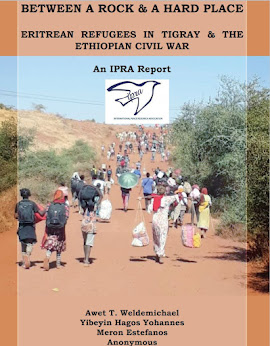
REPORT ON ERITREAN REFUGEES IN TIGRAY & THE ETHIOPIAN CIVIL WAR 2022
REPORT ON ERITREAN REFUGEES IN TIGRAY & THE ETHIOPIAN CIVIL WAR 2022
Monday, 7 February 2022
Do sanctions work ? The case of Eritrea
Do sanctions work ? The case of Eritrea says “no”
Eritrea has lived under United Nations economic sanctions for more than ten years without any notable impact on its politics or economy. Due to its covert economic operations and owing to weak and ineffective enforcement, Eritrea evaded the objective of the sanctions. A new unilateral sanction regime was recently re-imposed by the United States on the belligerent Horn of Africa nation – will the impact be different this time around?
Sunday, 16 January 2022
القرن الإفريقي عمقًا استراتيجيًّا خليجيًّا The Horn of Africa: A Gulf Strategic Depth, Dec 2021 book
القرن الإفريقي عمقًا استراتيجيًّا خليجيًّا
Al Jazeera Centre for Studies released a new book on 27 December 2021 entitled The Horn of Africa: A Gulf Strategic Depth by Madwakh Ajmi Al-Otaibi, professor of international relations at Joaan Bin Jassim Joint Command and Staff College in Qatar.
The book, which is originally a PhD thesis, aims to present geo-strategic, geo-economic and geo-cultural facts about the Horn of Africa as a Gulf strategic depth and attempts to answer a bundle of questions, such as: to which extent does the Horn of Africa make up one of the components of the strategic depth of the Arab Gulf? What is the nature of the fixed data that characterise the Gulf and Horn of Africa regions and render each of them a strategic depth to the other? What is the best means of building a Gulf strategic depth in the Horn of Africa according to the logic of strategic partnerships?
The Horn of Africa: A Gulf Strategic Depth is centred around the premise that the strategic depth of international politics in the new world order is based on an integrative relationship that reflects mutual interests between the parties concerned with defining strategic relations in aims of confronting mutual political, economic and security challenges. Thus, it attempts to tie the security and stability of the Horn of Africa and those of the Gulf region.

Saturday, 15 January 2022
Arabic on the Dahlak Islands (Eritrea)
Arabic on the Dahlak Islands (Eritrea)
Arabic in Contact. Linguistic and Sociolinguistic Perspectives, a 2014 article by Marie-Claude Simeone-Senelle
https://halshs.archives-ouvertes.fr/halshs-01112405/document
A Study on the Sources of the History of Arabic Curved Letters Dahlak Island in Eritrea: Inscriptions as a Model
أطروحة دكتوراه عن المصادر المؤرخة للخطوط اللينة (النسخ والثلث) نقوش جزيرة دهلك نموذجا بقلم الباحث: تاج الدين نور الدائم
A 2012 PhD Thesis on "A Study on the Sources of the History of Arabic Curved Letters Dahlak Island in Eritrea Inscriptions as a Model"

https://www.mediafire.com/file/q3nzuzguovetcqk/Dahlak+History+Curved+Arabic+PhD+Thesis.pdf/file
Tuesday, 23 November 2021
BIO NOTES ON ERITREAN PRESIDENT ISAIAS AFWERKI
BIO NOTES ON ERITREA/N PRESIDENT ISAIAS AFWERKI:
A detailed description of the personality of Isaias, a leaked cable written by US Embassy Asmara in 2008, his relations to #Tigray, conflict with Meles and he was called 'Wancha'-'Beer pot' in childhood

------------------------------------------------------
Another link (Aftenposten: 12.11.2008: BIO NOTES ON ERITREAN PRESIDENT ISAIAS AFWERKI (aftenposten.no)
BIO NOTES ON ERITREAN PRESIDENT ISAIAS AFWERKI
Date:2008 November 12, 10:55 (Wednesday)
Canonical ID: 08ASMARA543_a
Original Classification: SECRET, NOFORN
Current Classification: SECRET, NOFORN
CJTF-HOA J2X CAMP LEMONIER DJ | Central Intelligence Agency
| DJ QJQBOUTI | Defense Intelligence Agency | Ethiopia Addis Ababa | JICCENT
MACDILL AFB FL | Kenya Nairobi | National Security Council | Secretary of
Defense | Secretary of State | Sudan Khartoum | United States Africa Command |
United States Central Command | United States Naval Forces Central
DEPT FOR AF/EX AND AF/E
E.O. 12958: DECL:
11/05/2010 TAGS: PINR, ER
SUBJECT: BIO NOTES ON ERITREAN PRESIDENT ISAIAS
AFWERKI
REF: ASMARA 345 "IS ISAIAS UNHINGED?"
Classified By: Ambassador Ronald K. McMullen for reason
1.4(d)
- 1. (C) Summary: Isaias is an austere and narcissistic dictator whose political ballast derives from Maoist ideology fine-tuned during Eritrea´s 30-year war for independence. He is paranoid and believes Ethiopian PM Meles tried to kill him and that the United States will attempt to assassinate him. He is not notably nepotistic and has not favored his ancestral village or immediate family. This message includes some biographic tidbits offered as an addendum to USG bio information on foreign government leaders. End Summary.
- 2. (C) Aiming for 112: Isaias, 62, told a visiting German parliamentarian in late 2008 that he is healthy and expects to live another 40 or 50 years. He said he hopes to serve his country as long as he is able. In a May 2008 television interview, Isaias said Eritrea might hold elections "in three or four decades."
- 3. (S/NF) An Alleged Ethiopian Assassination Attempt: Isaias and Meles, brothers in arms during the 1980s, are now blood enemies. Why? In 1996, while returning from a vacation in Kenya, Isaias, his family, and his inner entourage stopped in Addis, where Meles offered to fly them back to Asmara in one of his aircraft. Isaias accepted the offer; en route, the aircraft caught fire but managed to turn back and land safely in Addis. According to someone who was on the aircraft, an infuriated Isaias accused Meles to his face of trying to kill him and his family. Isaias has not trusted Meles since, according to this source.
- 4. (S) Fears of an American Assassination Attempt: Isaias thinks the United States will attempt to kill him by missile strike on his residence in the city of Massawa, according to late 2007 information from the Force Commander of UNMEE.
- 5. (C) Holier Than Thou: Isaias has berated the Chinese ambassador in Asmara for China´s embrace of market capitalism. Isaias was sent to China by the Eritrean Liberation Front for political commissar training in the 1960s, where, according to the Chinese ambassador, "he learned all the wrong things." Isaias was turned off by the cult of personality surrounding Mao but apparently internalized Maoist ideology.
- 6. (C) Fluent in Arabic: Asmara-based Arab ambassadors are impressed by Isaias´ fluency in Arabic. There is some debate about where he learned it, but all agree he is a comfortable and capable Arabic speaker.
- 7. (C) Talented Speechwriter: In mid-2008, after Isaias delivered an impressive address in English to a gathering of ministerial-level representatives on the subject of Darfur, Yemane Ghebremeskel, the director of the office of the president, said Isaias had written the speech himself.
- 8. (C) Hot Temper: At a January 2008 dinner he hosted for a codel and embassy officials, Isaias became involved in a heated discussion with his Amcit legal advisor about some tomato seedlings the legal advisor provided to Isaias´ wife. Isaias complained that despite tender care by his wife, the plants produced only tiny tomatoes. When the legal advisor explained that they were cherry tomatoes and were supposed to be small, Isaias lost his temper and stormed out of the venue, much to the surprise of everyone, including his security detail.
- 9. (C) Holds a Grudge: A senior party official said Isaias and Djibouti President Guelleh had (g(eed during a ´u´e 2008 telephone conversation to try to resolve at the presidential level issues related to the June border clash. According this senior Eritrean official, Isaias was livid when Guelleh supposedly shortly thereafter lambasted Eritrean aggression in a media interview. Isaias reportedly felt personally betrayed by President Guelleh, and has been obstinate about resolving the Djibouti-Eritrea border dispute ever since.
- 10. (C) Thin Skinned: Isaias asked to be named the patron of the World Bank-funded Cultural Assets Rehabilitation Project (CARP). When individuals involved with CARP published the book "Asmara: Africa´s Secret Modernist City," it failed to include a note of thanks to CARP´s patron. Isaias was miffed and shut down CARP.
- 11. (C) Good Op-Sec: Isaias has an aversion to talking on the telephone and frequently sleeps in different locations to foil a coup or assassination attempt. During the winter months he spends most of his time in Massawa rather than in Asmara. When dining in restaurants, Isaias will often switch plates with a subordinate, apparently to avoid being poisoned, according to the Qatari ambassador.
- 12. (C) The Early Years of Little Beer Pot: Isaias´ father, Afwerki, comes from the village of Tselot, which is perched on the lip of a 7,000´ escarpment four miles southeast of Asmara. When Isaias was a boy Afwerki reportedly spent much of his time in Tigray, where he owned a coffee farm that was later nationalized by the Derg. With Afwerki largely absent, Isaias lived with his mother (rumored to have family roots in Tigray) in a working class neighborhood in eastern Asmara near the train depot and the Lutheran church. Isaias´ mother made and sold a traditional beer called sewa. By some accounts, Isaias was nicknamed the Tigrinya equivalent of "Beer Pot," after the ceramic jug from which sewa is dispensed.Q Qoday he is a QeQvy whisky drinker, but perhaps as a youth his nickname referred as much to his habits as to his mother´s business.
- 13. (C) No Pork for His Ancestral Village: In November 2008 emboffs visited Tselot and saw no indication that the village has received any special favor from Isaias. Like most Eritrean villages, it has electricity but no running water or sewer system. Gaunt cattle and untended donkeys roam the village. Their droppings are quickly gathered and formed into oval patties, which are then stuck on rock walls, dried, and used as fuel for cooking. Afwerki is said to be buried in the village cemetery, but emboffs could not locate his grave. Isaias´ immediate family is rarely featured in the state-run media and keeps a low profile. Although his portrait adorns many shops in Asmara, there is no cult of personality in Eritrea. Isaias often appears in the media clad casually in slacks, jacket, open-necked shirt, and sandals or loafers. He rarely travels in a motorcade.
- 14. (C) Hard-hearted: When a visiting U.S. movie star in early 2008 raised the plight of two Embassy Asmara FSNs who have been imprisoned without charge since 2001, Isaias glared stonily at her and replied, "Would you like me to hold a trial and then hang them?"
MCMULLEN
Friday, 12 November 2021
Ethiopia & Eritrea Peace Treaty of 2018 and End of UN-Sanctions Documentation
Ethiopia ; Eritrea Peace Treaty of 2018 and End of UN-Sanctions
Documentation
Compiled by Hans-Ulrich Stauffe
https://reliefweb.int/sites/reliefweb.int/files/resources/Full_Report_1869.pdf
Sunday, 31 October 2021
DIPLOMACY, THE ERITREA-ETHIOPIA PEACE DEAL AND ITS IMPLICATIONS 2019
DIPLOMACY, THE ERITREA-ETHIOPIA PEACE DEAL AND ITS IMPLICATIONS
Author(s): Michael ASIEDU
Global Political Trends Center
https://www.jstor.org/stable/pdf/resrep19344.pdf
SCENARIOS FOR POST-ISAIAS ERITREA ICG 2013
Scenarios for Post-Isaias Eritrea
International Crisis Group
https://www.jstor.org/stable/pdf/resrep31952.8.pdf
Eritrea: Ending the Exodus? 2014
Eritrea: Ending the Exodus?
Author(s): International Crisis Group
International Crisis Group (2014)
href="https://www.jstor.org/stable/pdf/resrep32092.pdf?
Saturday, 2 October 2021
ሐጺር ታሪኽ መቦቀል ትውልዲ ኤርትራ Origin of the Eritrean people by compiled by Conti Rossini
ሐጺር ታሪኽ መቦቀል ትውልዲ ኤርትራ
Translated from "Proverbi tradizioni e canzoni tigrine by Conti Rossini"

Proverbs, traditions, and Tigrinya songs
----------------------------------------
Thanks to Abba Kibrom Tseggai for sharing
Sunday, 16 May 2021
Eritrea-Ethiopia Boundary Commission FINDINGS April 2002
Eritrea-Ethiopia Boundary Commission FINDINGS April 2002
English Version: Cases | PCA-CPA
Republic of Ethiopia and the State of Eritrea. On 12 December 2000, the Governments of Ethiopia and Eritrea concluded the Algiers Agreement which terminated military hostilities and provided, inter alia, for the establishment of the Boundary Commission. The Boundary Commission was mandated to delimit and demarcate the colonial treaty border based on pertinent colonial treaties (1900, 1902 and 1908) and applicable international law.
The Boundary Commission was seated in The Hague with the Permanent Court of Arbitration serving as registry and the UN Cartographic Section providing technical support. The Chief of the UN Cartographic Section was appointed as the Boundary Commission's Secretary. As provided in the Algiers Agreement, the Secretary reviewed the claims and evidence of the Parties and identified the portions of the border which were not in dispute.
In Article 4(1) of the Algiers Agreement, the Parties reaffirm the principle of respect for the borders existing at independence as espoused by the OAU Summit in Cairo in 1964 (principle of uti possidetis). In its delimitation decision, the Boundary Commission had regard to this principle and also to the role of subsequent conduct of the Parties, including inter alia activities on the ground tending to show the exercise of sovereign authority (effectivités). The colonial treaties of 1900, 1902 and 1908 related, respectively, to the central, western, and eastern sectors of the boundary. In each of these sectors, the Boundary Commission determined the boundary by reference to the pertinent colonial treaty as modified, where relevant, by the subsequent conduct of the Parties. The Boundary Commission set out its description of the boundary as so determined in a unanimous decision dated April 13, 2002.
The second part of the Boundary Commission's mandate was to demarcate the boundary. Upon the issuance of the delimitation decision, the Parties announced their full acceptance of the decision and called upon the Boundary Commission to conduct an expeditious demarcation. The Boundary Commission issued Demarcation Directions on July 8, 2002 and established field offices in Asmara, Addis Ababa and Adigrat. Between March and August 2003 the Boundary Commission completed part of the demarcation in the eastern sector. When the Boundary Commission attempted to commence demarcation in the central and western sectors, an impasse arose between the Parties after Ethopia called into question certain parts of the delimitation decision.
Having been unable to continue with the demarcation, the Boundary Commission held a meeting with the Parties in March 2006, with a view to enabling the resumption of demarcation activities, but without success. The UN Security Council was seized of the situation and requested that the Parties comply with their obligations under the Algiers Agreement. Following further unsuccessful attempts to meet with the Parties, the Boundary Commission met in private session at The Hague on November 20, 2006. On November 27, 2006 the Boundary Commission issued a Statement on an alternative approach of identifying the location of points for the emplacement of pillars by the use of image processing and terrain modeling techniques. The Statement provided inter alia that if by the end of November 2007 the Parties had not reached agreement on the emplacement of pillars, the boundary would automatically stand as demarcated by the boundary points listed in the annex to the Statement. Following a meeting with the Parties held on September 6 and 7, 2007 which did not yield any agreement, the Boundary Commission determined, on November 30, 2007, that the pillar locations identified in the annex to the Statement became binding on the Parties.
Eritrea-Ethiopia Claims Commission Findings August 2009
Permanent Court of Arbitration Eritrea-Ethiopia Claims Commission
English Version: Cases | PCA-CPA
Following the breakout of armed conflict between the Federal Democratic Republic of Ethiopia (“Ethiopia”) and the State of Eritrea (“Eritrea”) in May 1998, the governments of Ethiopia and Eritrea “permanently terminate[d] military hostilities between themselves” pursuant to an agreement signed in Algiers on 12 December 2000 (the “Algiers Agreement”).
Two commissions were established under the Algiers Agreement. Article 4 provided for the establishment of a Boundary Commission and Article 5 provided for the establishment of a Claims Commission.
The Claims Commission was established to “decide through binding arbitration all claims for loss, damage or injury by one Government against the other” related to the armed conflict and resulting from “violations of international humanitarian law, including the 1949 Geneva Conventions, or other violations of international law.” The Parties were entitled to submit claims on their own behalf and on behalf of their nationals (including both natural and legal persons), or in appropriate circumstances, persons of Ethiopian or Eritrean origin who were not nationals.
The Commission was seated in The Hague with the Permanent Court of Arbitration serving as registry.
Between July 2001 and August 2001, the Commission held hearings on significant questions related to jurisdiction, procedure and possible remedies. The Commission addressed these issues in Decisions 1-5, issued in August 2001.
In October 2001, the Commission adopted its Rules of Procedure following consultation with the Parties. These rules were based on the Permanent Court of Arbitration Optional Rules for Arbitration Disputes Between Two States.
The Parties filed their claims by 12 December 2001, addressing matters including the conduct of military operations in the front zones, treatment of prisoners of war, treatment of civilians and their property, diplomatic immunities and the economic impact of certain government actions during the conflict.
The Commission decided to bifurcate proceedings, dealing first with issues of liability and reserving the determination of damages for a later stage. The Commission heard: the prisoner of war claims in December 2002; the Central Front claims in November 2003; the Home Front claims in March 2004; and the remaining liability claims in April 2005. The Commission held two rounds of hearings on damages in April 2007 and May 2008.
In total, the Commission delivered 15 partial and final awards on liability and concluded its work on 17 August 2009, when it delivered its final awards on damages.
Subscribe to:
Posts (Atom)